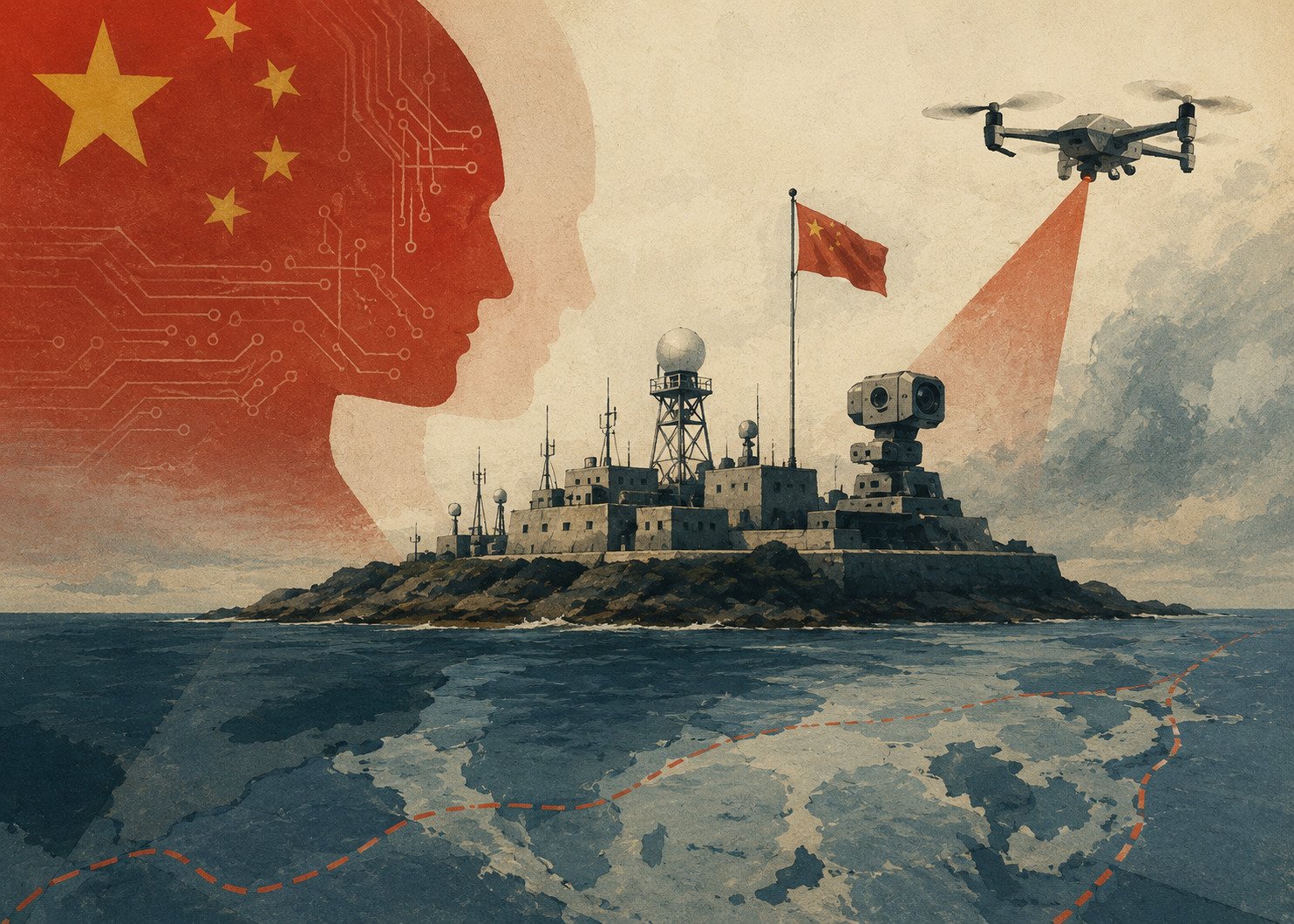
The South China Sea continues to be a hotbed of geopolitical tension and rapid developments, with China accelerating the construction of new facilities on disputed features, the U.S. Navy facing operational setbacks, and regional actors pushing for diplomatic solutions to contested waters. These activities have significant implications for military readiness, resource access, and the shifting balance of power in Asia.
China Completes First Stage of Construction at Disputed South China Sea Reef
Satellite images have confirmed that China has completed the first phase of construction at a disputed reef in the South China Sea, signaling Beijing’s ongoing efforts to enhance its infrastructure in contested waters. The construction milestone, which was captured by multiple independent imaging sources, underscores China’s commitment to expanding its footprint and capabilities on maritime features claimed by several neighboring countries. The development has raised alarms across the region, given its strategic location and potential role in consolidating Chinese control.
Sources: China completes first stage of work at South China Sea reef, images show – news.tv5.com.ph, China Completes First Stage of Work at Disputed South China Sea Reef, Images Show – The China-Global South Project, China completes first stage at disputed reef – Taipei Times, China completes first stage of work at disputed South China Sea reef, images show – Awani International
U.S. Navy Destroyer Stranded in South China Sea for Four Days
The USS Benfold, a U.S. Navy destroyer, was left powerless and adrift for four days in the South China Sea last month due to an engineering casualty. The ship was unable to maneuver or provide basic services for the crew during this period. This high-profile incident, confirmed by multiple sources and official statements, has raised significant questions about U.S. Navy operational readiness and maintenance protocols in contested waters. An official investigation has been launched into the cause of the power failure, which underscores vulnerabilities in U.S. military deployments in the region at a time of rising strategic competition.
Sources: U.S. Navy destroyer lost power for 4 days in South China Sea – The Washington Post, US navy destroyer adrift in South China Sea for four days after losing power – The Guardian, Navy destroyer stuck in South China Sea for 4 days without power – Washington Times, Navy destroyer went days without power in the South China Sea, leaving sailors without toilets – The Hill, US Navy destroyer spent 4 days without power in South China Sea – Military Times
Philippines, Malaysia, and ASEAN Push for Progress on South China Sea Code of Conduct
The Philippines, supported by Malaysia and other ASEAN members, has expressed optimism for concluding negotiations on the Code of Conduct (COC) for the South China Sea by 2026. Both countries reiterated their commitment to accelerate talks, seeking to establish a framework to manage disputes, improve security cooperation, and reduce the risk of serious maritime incidents. The COC negotiations between ASEAN and China have seen renewed diplomatic engagement in recent months.
Sources: Philippines optimistic South China Sea Code of Conduct talks will conclude in 2026 – Manila Bulletin, PH, Malaysia push for South China Sea code deal this year – politiko.com.ph, PH hopeful SCS Code of Conduct issues may be resolved soon – Inquirer.net
China Proposes AI-Driven Robotic Fortresses on Disputed Islands
The China Coast Guard has proposed turning certain South China Sea islands into unmanned, AI-powered outposts, aiming to increase control over disputed maritime features. These planned “robot fortresses,” featuring automation and drone surveillance technologies, are designed to reinforce Beijing’s sovereignty claims and monitoring capabilities in the region. The initiative marks a leap in the use of artificial intelligence and robotics for maritime security, further fueling concerns over militarization and the potential for escalation.
Sources: Chinese coastguard proposes turning South China Sea isles into robotic fortress – South China Morning Post, China plans to transform disputed islands in the South China Sea into robotic fortresses – Наша Ніва
China Announces New Monitoring Station Near Scarborough Shoal
Beijing has revealed plans to build a monitoring station near Scarborough Shoal, an area claimed by both China and the Philippines. The announcement has heightened tensions with Manila, which views the move as a direct challenge to its maritime claims. Chinese experts have justified the construction as necessary for sovereignty, public services, and local livelihoods, while the Philippines regards the development as part of a broader expansion of Beijing’s observation and control network across the South China Sea.
Sources: China to build monitoring station near disputed Scarborough Shoal – South China Morning Post
China Expands Military and Civilian Infrastructure Across the South China Sea
New satellite imagery reveals a dramatic acceleration of Chinese land reclamation, military base construction, and infrastructure expansion across contested islands and reefs in the South China Sea. Facilities reportedly include deepwater harbors, airstrips, and other dual-use installations, particularly at features such as Antelope Reef. These projects are seen as part of China’s broader campaign to fortify its presence and assert control, with implications for regional security dynamics and Taiwan’s strategic environment.
Sources: New images show breakneck pace of Beijing’s land grab in South China Sea – The Telegraph, With deepwater harbour & runway, China expands control of disputed Antelope Reef in South China Sea – Firstpost
ASEAN Diplomacy and U.S.-Philippines Regional Security Cooperation
Efforts to address security and maritime disputes through regional diplomacy have intensified, with Philippine and Malaysian officials, including top foreign ministers, meeting to discuss strategies and cooperation. Meanwhile, the United States and regional powers, such as Australia and Japan, continue to strengthen their maritime and military cooperation with the Philippines to monitor and counter aggressive activity in the South China Sea.
Sources: DFA Sec. Lazaro, Malaysian counterpart meet to discuss regional maritime issues – GMA Network
Broader Regional Implications and Strategic Significance
Analysis from international media notes that the South China Sea remains a flashpoint of global strategic importance, with implications for U.S.-China relations, the security of neighboring states, and vital international shipping lanes. The confluence of rising military activity, legal disputes over maritime boundaries and continental shelves, and competition over natural resources is shaping the broader Indo-Pacific security architecture.
Sources: Why Taiwan and the South China Sea matter to the US and the world – AP News
Philippines Explores Joint Resource Ventures, Asserts Legal Claims
The Philippine president reiterated that joint resource exploration with China remains a viable possibility before 2028, despite ongoing disputes. Manila is also strengthening its legal posture by emphasizing its rights over its continental shelf and historical titles, including Scarborough Shoal, in response to Chinese expansion and infrastructure development near Philippine-claimed zones.
Sources: Joint Resource Exploration With China a ‘Possibility’ Before 2028, Philippine President Says – The Diplomat – Asia, Continental Shelf is Manila’s New Front in South China Sea Dispute – Asia Sentinel
China Accelerates Paracel Islands Militarization
China has stepped up its efforts to complete military installations on the Paracel Islands, further entrenching its control in the strategically significant area. The rush to finish these facilities is viewed as part of Beijing’s broader campaign to strengthen its position in the South China Sea and signal its resolve to both regional claimants and external powers.
Sources: China Rushes to Complete Paracel Island Militarization – The Maritime Executive
Diplomatic, Strategic, and Legal Maneuvering Intensifies
Regional powers and the Philippines continue to navigate the complex maritime landscape through a mix of diplomacy, legal arguments, and military modernization. The deployment of BrahMos missiles by the Philippines, new surveillance platforms from Australia, and concerted ASEAN engagement all point to intensifying efforts to deter coercion and defend interests as the South China Sea remains central to wider Indo-Pacific security contests.
Sources: Philippines’ BrahMos Missile Wall Could Reshape the South China Sea – Defence Security Asia, Australia Improves its Surveillance Capability Over the South China Sea – The Maritime Executive
China Releases Ecological Report to Bolster Regional Claims
China has issued an ecological stability report for the South China Sea, asserting that its expanding operations have not harmed the marine environment. The release appears aimed at strengthening Beijing’s territorial claims and countering criticism from other claimant states and external powers.
Heightened Tensions Over Chinese Military Upgrades in the Region
China’s proposals to further upgrade and militarize its South China Sea holdings have sharpened concerns among other claimants, particularly the Philippines, about the risk of conflict and sovereignty challenges. The strategic use of civil and military facilities, coupled with public messaging from Beijing, reflects efforts to normalize Chinese control and deter external intervention.
Papaper Trail and Legal Claims to Scarborough Shoal
The legal and historical foundations for the Philippines’ claim to Scarborough Shoal are under renewed scrutiny, as Manila seeks to defend its interests before the international community amid continued Chinese construction and monitoring near the contested feature.
Sources: Scarborough Shoal and the Philippines’ Paper Trail in the South China Sea – The Maritime Executive
Strategic and Opinion Commentary Emphasize Zero Tolerance, Regional Risks
Opinions and expert commentary emphasize the need for Manila to adopt a zero-tolerance posture toward further maritime encroachment and highlight the enduring risks of military miscalculation in the South China Sea. U.S. policy discussions focus on Washington’s role in supporting Philippine security and coping with regional strategic dilemmas.
Sources: Zero-tolerance posture against China is needed in ‘West Philippine’ Sea – Nikkei Asia, Op-Ed: Elbridge Colby’s S. China Sea Reassurance Deepens Manila’s Trilemma – The Maritime Executive
South China Sea as a Persistent Flashpoint
The South China Sea remains a persistent flashpoint, where the interests of the U.S., China, ASEAN members, and other regional powers intersect, shaping the security, legal, and economic landscape for years to come.
Sources: A Rock and China’s Three-Sea Problem – War on the Rocks
In summary, the convergence of aggressive infrastructure developments, military incidents, diplomatic negotiations, and evolving legal arguments has increased the complexity—and vulnerabilities—around the South China Sea, a region central to Asian security and global economic stability.