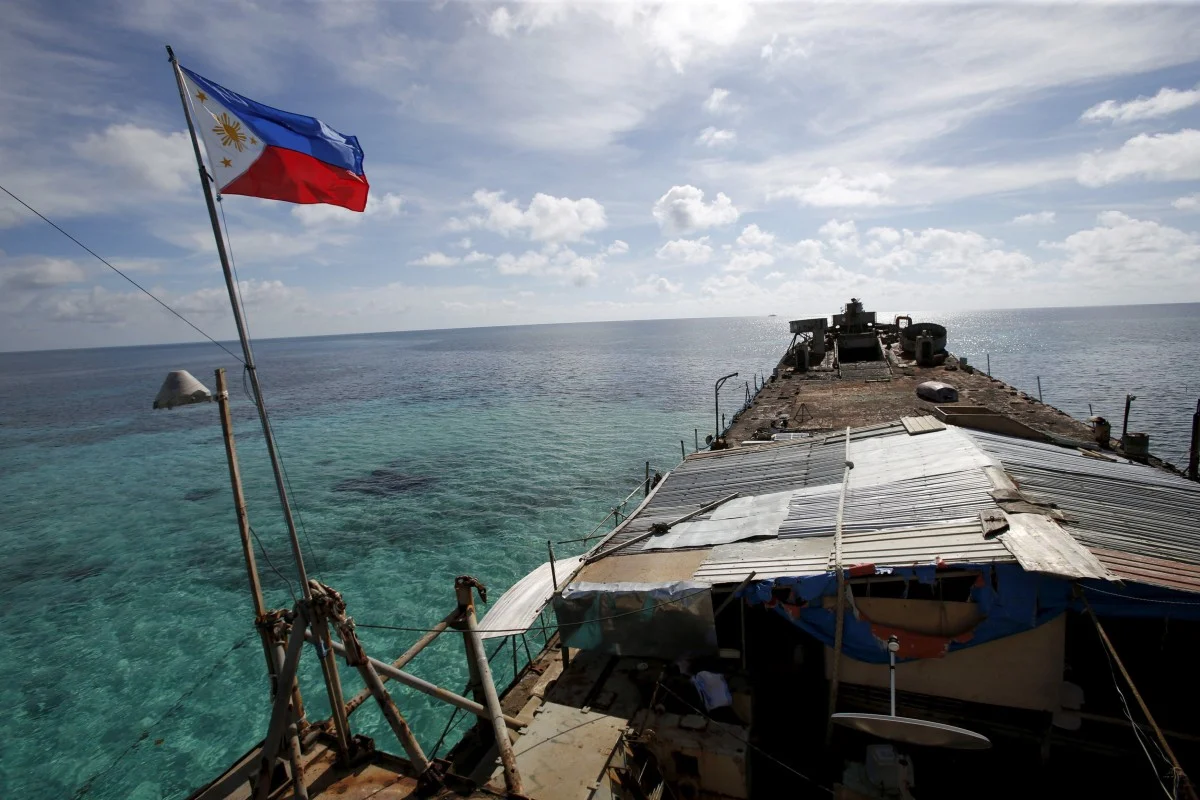
The South China Sea/West Philippine Sea remained a focal point of diplomatic contention and activity this week as Manila formally denied any agreement with Beijing to remove the grounded BRP Sierra Madre at Ayungin (Second Thomas) Shoal, while Chinese state media and officials publicly rejected Philippine maritime claims. The developments unfolded alongside naval operations by the US Navy and partners, Chinese research missions near Scarborough Shoal, scientific and environmental incidents at sea, and renewed international and civil-society attention to the 2016 arbitral ruling — underscoring a mix of diplomatic dispute, maritime presence and scientific activity in the contested waters.
Philippines denies any deal to remove BRP Sierra Madre from Ayungin Shoal
The Philippine Department of Foreign Affairs rejected recent Chinese assertions that Manila had promised to remove the grounded BRP Sierra Madre from Ayungin (Second Thomas) Shoal, saying there is no such agreement. Multiple Philippine outlets reported the DFA’s denial and framed Chinese references to an alleged arrangement as incorrect; coverage noted Philippine officials have publicly debunked or rejected the claim. Secondary reporting flagged the question to Beijing about what agreement it was referring to, reflecting confusion between the two capitals over any purported understanding on the grounded vessel.
Sources: No PH-China deal to remove BRP Sierra Madre — DFA, DFA to China: What agreement to remove BRP ‘Sierra Madre’?, Phl debunks China’s claims: No such deal to remove BRP Sierra Madre
Beijing publicly dismisses Philippine maritime claims
Chinese state media and official commentary this week framed Manila’s maritime claims in the South China Sea as unlawful, with a suite of outlets and reports describing Philippine assertions over features in the Spratly (Nansha) area as being rejected by Beijing. Coverage included direct statements from Chinese sources characterizing the Philippine position as “illegal, null and void” or otherwise unacceptable, and broader commentary from Chinese outlets warning that Philippine actions would not advance its development. Regional and international outlets also reported China’s public rebuttals and dispute of Philippine maritime jurisdiction claims.
Sources: Beijing rejects Manila’s unlawful maritime claims, China disputes Philippines’ maritime jurisdiction, China rejects Philippines’ claims on reefs and island of Nansha Islands, ‘Illegal, null and void’: China dismisses Philippine South China sea claims
Poland urges China to comply with 2016 arbitral award, backing Manila
Poland publicly supported the Philippines’ call for China to comply with the 2016 arbitral ruling on the South China Sea, according to reporting from Philippine outlets. The statement of support was reported by ABS-CBN and echoed in secondary coverage, indicating an international affirmation of the arbitral award and a diplomatic push for adherence to its findings.
Sources: Poland says China obligated to comply with 2016 Arbitral award, Poland backs Philippines on 2016 arbitral award
Chinese research vessel completes month-long mission near Scarborough Shoal
A Chinese research ship concluded a month-long mission near Scarborough Shoal, according to reporting. Coverage described the vessel’s operation in the vicinity of the contested feature and noted the completion of its scientific or survey activities there.
Sources: Chinese research ship completes mission near Scarborough Shoal
Armed Forces of the Philippines reports no evidence of Chinese drilling at Bajo de Masinloc
The Armed Forces of the Philippines reported it found no evidence that China conducted drilling at Bajo de Masinloc (the Scarborough/Panatag area), according to Philippine coverage. The AFP’s assessment was presented in reporting that addressed local concerns about possible activity in the area.
Sources: AFP finds no evidence of Chinese drilling at Bajo de Masinloc
US carrier Abraham Lincoln, allied units operate in South China Sea
The aircraft carrier USS Abraham Lincoln conducted operations in the South China Sea after a port call in Thailand and was reported operating alongside Australian naval units. Coverage noted the carrier’s presence in the contested waters as part of routine operations with partners in the region.
Sources: Carrier USS Abraham Lincoln operates with Australians in the South China Sea, After Thailand port call, USS Abraham Lincoln operates with Australian frigate
US destroyer USS Benfold conducts weapons and small-arms qualifications in the South China Sea
US Navy releases reported that the destroyer USS Benfold conducted weapons qualifications and small-arms qualifications while operating in the South China Sea. The actions were described in official Navy reporting as routine training and qualifications conducted during regional operations.
Sources: USS Benfold conducts weapons qualification in South China Sea, USS Benfold conducts small arms quals in South China Sea
Underwater perovskite solar cells tested successfully beneath South China Sea surface
Scientists reported successful trials of perovskite-based underwater solar cells operating beneath the South China Sea surface. Reports described functioning demonstrations at depths reported variously as about 10 metres (32 feet) and highlighted the technology’s ability to generate power undersea in trial conditions.
Sources: Scientists test underwater perovskite solar cells 32 ft below surface, Underwater solar cells generate power at 10 m depth in trial
Drilling accident in the South China Sea triggered a methane leak, reports say
Reporting described a drilling accident in the South China Sea that triggered a methane leak. Coverage noted the incident and reported the leak was rapidly contained by natural deep-sea processes or activity, according to the account in the environmental and diving-focused reporting.
Sources: Drilling accident triggered methane leak, quickly contained
Chinese defence chief urges end to ‘provocative acts’ at Xiangshan Forum as tensions persist
At the opening of a regional security forum, China’s defence minister called for an end to “provocative acts” and urged restraint as tensions persist in regional waters. Reporting on the Xiangshan Forum noted the defence chief also sought consensus on global security topics and avoided direct naming of certain flashpoints or countries while calling for cooperation in emerging domains such as AI and space.
Sources: China defence minister urges end to ‘provocative acts’ at security forum, Forum coverage: Xiangshan remarks and regional context
US-backed submarine cable studies aim to route around the South China Sea
The US Trade and Development Agency backed a feasibility study for a transpacific submarine cable linking the United States and Thailand (and other Southeast Asian partners) that would avoid routing through the South China Sea. Reporting on the initiative framed it as part of efforts to build alternative, “trusted” digital infrastructure that does not transit the contested waters.
Sources: US backs Thai transpacific cable study avoiding South China Sea, USTDA funds study for a ‘trusted’ Thailand-US subsea cable
Regional disputes and dialogue: Seoul note spat, Taiwan objection, civil mobilisation
Analysts flagged a diplomatic spat stemming from a “mysterious note” at a Seoul defence dialogue that contributed to tensions between the Philippines and China, while Taiwan’s Foreign Ministry said it opposed “excessive claims” after Philippine moves concerning Scarborough Shoal. Meanwhile, civil society and academic voices in the Philippines sought to mobilize public reflection and action on the 10th anniversary of the 2016 arbitral ruling, marking a continuing domestic engagement with the legal and political dimensions of maritime disputes.
Sources: Analysis: Seoul Defence Dialogue note leads to Philippines-China spat, Taiwan opposes ‘excessive claims’ after Philippine push on Scarborough, Mobilizing Filipino voices on 10th anniversary of 2016 arbitral ruling
Policy debate continues over maritime militia and regional approaches
Analysis in regional media asked whether Beijing should employ its maritime militia as a backup force in the South China Sea, contributing to an ongoing policy debate about the role of paramilitary and civilian maritime actors in contested waters. Broader opinion pieces also warned that unresolved maritime border disputes across the Global South carry risks if left to fester, urging attention to diplomatic and legal pathways for resolution.
Sources: Should Beijing use maritime militia as backup force?, Opinion: Global South cannot let maritime disputes fester