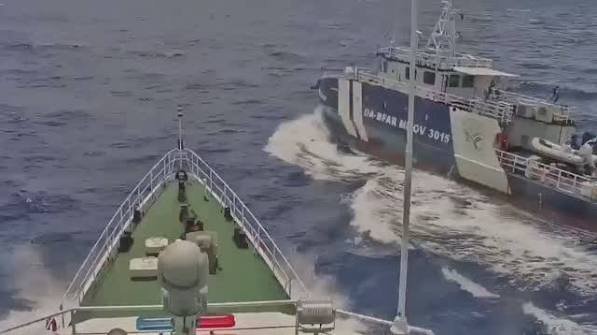
A collision between a China Coast Guard vessel and a Philippine government fisheries/resupply ship off Palawan has sparked a flurry of official statements, contrasting video accounts and broader regional responses. Philippine authorities say the Chinese ship rammed a Bureau of Fisheries and Aquatic Resources (BFAR) vessel that was on a refuelling or subsidy mission to Filipino fishers; China and state-affiliated media have offered conflicting accounts. The incident has prompted diplomatic appeals to avoid escalation, condemnation from Philippine task forces and civil-society voices, and wider discussion about the security and economic pressures on fishing communities in the disputed waters.
Alleged ramming of BFAR resupply vessel off Palawan
The Philippine Coast Guard and multiple Philippine outlets reported that a China Coast Guard ship struck a BFAR resupply/refuelling vessel near Palawan. Philippine authorities described the BFAR vessel as conducting a fuel-subsidy or refuelling mission for fishers when the collision occurred; video footage circulated by various outlets appears to show a contact between the two ships. International and Philippine media cited the coast guard’s account that the Chinese vessel rammed the Philippine boat, and those reports said the BFAR vessel sustained significant damage.
China’s side provided contrasting accounts. State and Chinese-affiliated outlets published footage and commentary suggesting the Philippine vessel manoeuvred across the China Coast Guard ship’s bow prior to the contact, and Chinese statements blamed the Philippine vessel for the collision. The differing narratives have left the basic facts of fault contested in public reporting.
Sources: PCG: China Coast Guard ship rams BFAR vessel off Palawan, Al Jazeera: Chinese ship rams Philippines gov’t vessel in South China Sea, GMA Network: Chinese vessel rams PH ship on fuel subsidy mission near Palawan, Baird Maritime: VIDEO | Chinese ship rams Philippine resupply vessel in disputed waters
Diplomatic fallout and calls to avoid escalation
The Philippine Department of Foreign Affairs publicly urged China to avoid escalation after the collision, while Philippine officials and task forces condemned the incident. Manila’s National Task Force for the West Philippine Sea described the ramming as condemnable, and media coverage recorded the DFA characterising the conduct cited by the Philippines with strong language.
China’s embassy and the China Coast Guard issued counter-statements blaming the Philippine vessel and warned against what Beijing called maritime infringements and provocations. Regional and multilateral concern was reported: the Philippines said ASEAN expressed worry about recent events in the South China Sea. The exchanges illustrate the immediate diplomatic strain following the incident and reflect competing claims about what occurred on the water.
Sources: DFA to China: Avoid escalation after collision off Palawan, NTF-WPS condemns China’s ramming of BFAR vessel off Palawan, Manila Bulletin: Chinese Embassy, CCG blame Philippine vessel for South China Sea collision, China urges Philippines to immediately stop maritime infringement, provocations, Philippines says ASEAN concerned about recent events in S China Sea
Impact on fishers and aid operations
The collision occurred against a backdrop of Philippine efforts to support coastal fishers who report declining catches and incomes tied to the South China Sea disputes. A feature on Filipino fishers detailed how maritime tensions and access issues are affecting livelihoods, while the Philippine Coast Guard reported spotting Chinese vessels in Bajo de Masinloc as the government distributed aid to fishers in the area.
Philippine reports said the BFAR vessel was delivering fuel subsidies or refuelling services to fishers at the time of the incident, emphasising the local economic stakes tied to maritime operations and patrolling in contested waters.
Sources: SCMP: Filipino fishers count the cost of South China Sea dispute, GMA Network: PCG: Chinese vessels seen in Bajo de Masinloc as PH distributes aid to fishers
Video evidence and competing footage
Multiple outlets circulated video of the contact. Independent and industry outlets published footage that appears to show the collision during the BFAR vessel’s resupply mission; Philippine state broadcasters and social feeds also posted images and video claiming heavy damage to the BFAR boat. Chinese state-affiliated media released footage it said showed the Philippine vessel cutting repeatedly across the China Coast Guard ship’s bow before the contact.
The availability of differing clips and the competing readings offered by Philippine and Chinese outlets have made visual evidence a central but contested element of reporting about the incident.
Sources: Baird Maritime: VIDEO | Chinese ship rams Philippine resupply vessel in disputed waters, PTV Facebook segment: BFAR vessel sustained heavy damage after ‘intentional’ ramming, Global Times: Exclusive footage shows Philippine vessel repeatedly cutting across CCG vessel’s bow before collision
Regional security, infrastructure and legal context
The collision comes amid continuing regional military activity and policy moves. A U.S. destroyer, USS Benfold, was reported to have conducted a live-fire exercise in the South China Sea and to have conducted replenishment-at-sea with an Australian vessel, illustrating active naval operations in the area. Separately, the U.S. Trade and Development Agency is funding a feasibility study for a transpacific submarine cable project that would avoid the South China Sea, a move noted in reporting on infrastructure choices tied to maritime risk.
Analysts have also highlighted shifting local military balance points — including attention to Balabac in the Philippines — while legal and diplomatic conversations continue: a Toronto forum marked the tenth anniversary of the 2016 arbitral award, and Chinese media and officials reiterated Beijing’s long-standing rejection of the award as illegal and void. International and regional workshops on sustainable fisheries have proceeded even as tensions persist, and Taiwan’s foreign ministry registered opposition to what it described as excessive claims after Philippine moves around Scarborough Shoal.
Sources: USS Benfold conducts live-fire exercise in South China Sea, USS Benfold replenishment-at-sea with HMAS Supply, SCMP: US throws weight behind Thai submarine cable that skips South China Sea, Why Balabac Is Reshaping the South China Sea Military Balance, Toronto forum marks 10 years since South China Sea arbitral award, China again calls 2016 South China Sea arbitral award ‘illegal, null and void’, Int’l workshop on South China Sea sustainable fisheries held in Nanning, Taiwan Foreign Ministry: opposes excessive claims after Philippine Scarborough Shoal push
Conclusion
The collision off Palawan has become a focal point for competing narratives, immediate diplomatic friction and wider concern about the human and strategic costs of maritime disputes. Philippine authorities, Chinese officials and international observers are continuing to circulate differing accounts and assessments; reporting so far shows the incident has already fed into regional political, security and economic discussions rather than resolving questions about responsibility at sea.