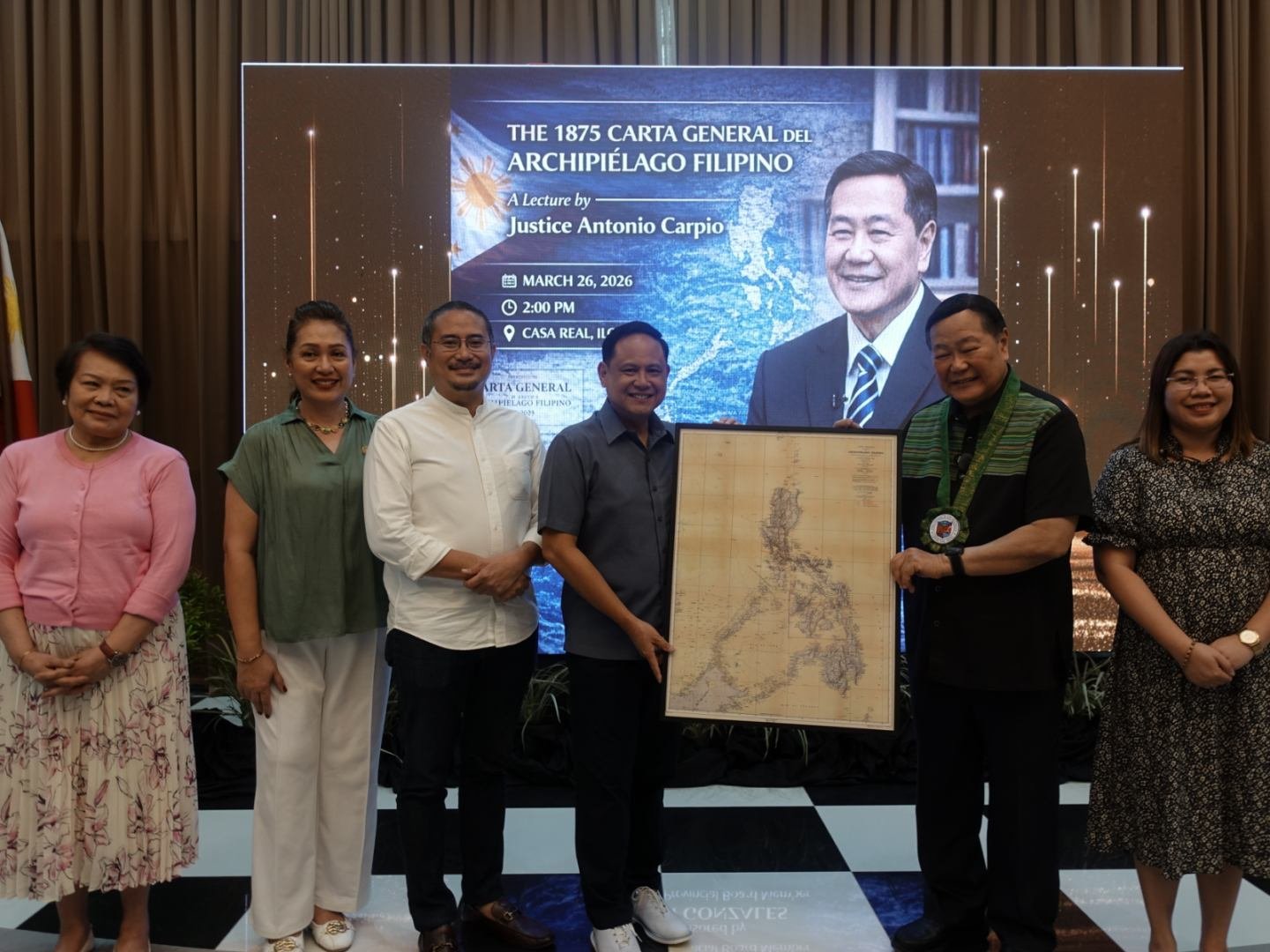


Last April 26, 2026, Justice Carpio gave five copies of the 1875 Carta General del Archipielago Filipino to the Office of Iloilo Governor Art Defensor Jr.
Justice Carpio delivered a lecture to Iloilo students, public teachers and provincial government employees explaining the significance of the 1875 map to Philippine sovereignty over the Kalayaan Island Group and Scarborough Shoal.
Understanding Sovereignty Through Law and History
The lecture emphasized that Philippine claims in the West Philippine Sea are not recent assertions, but are rooted in long-standing legal and historical records.
Participants were introduced to the importance of foundational maps, including:
- The 1734 Murillo Velarde map
- The 1808 Spanish map
- The 1875 Carta General del Archipiélago Filipino
These maps consistently depict key features such as Scarborough Shoal (Bajo de Masinloc) and the Kalayaan Island Group (Spratlys) as part of Philippine territory.
This continuity, spanning centuries, forms part of the legal basis for the country’s sovereign rights.
The 1875 Carta General as Foundational Evidence
Particular emphasis was placed on the 1875 Carta General, widely regarded as the most complete Spanish-era map of the Philippine archipelago.
More than a historical document, the map:
- Identifies maritime features with precision
- Includes depth soundings and named islands
- Reflects official territorial understanding recognized across colonial administrations
Within the framework of international law, such documentation strengthens the Philippines’ position by demonstrating consistent territorial definition over time.
Beyond Sovereignty: Economic Stakes
The discussion made clear that the West Philippine Sea is also an economic lifeline.
The region:
- Serves as a major source of the country’s fish supply
- Holds potential reserves of oil and natural gas
- Plays a crucial role in energy security
This underscores that the issue is not only about defending territory—but about protecting resources essential to national development.
Educating the Next Generation
Local officials emphasized the urgency of integrating the West Philippine Sea issue into education.
Arthur Defensor Jr. stressed the need to equip the youth with a clear understanding of international law and territorial rights, noting that awareness is key to protecting sovereignty.
The initiative reflects a broader push to ensure that future generations understand both the legal foundations and strategic importance of the issue.
Toward a National Narrative
A recurring theme in the lecture was the importance of clarity—both in law and in public understanding.
The West Philippine Sea dispute requires:
- A consistent legal framework
- A unified historical narrative
- Evidence grounded in treaties, maps, and international law
Without this, the Philippines risks weakening its position in the eyes of the global community.
Conclusion
The Iloilo lecture reinforced a central message: the West Philippine Sea is not a distant geopolitical issue—it is a national concern that touches on sovereignty, resources, and the country’s future.
Grounded in historical maps like the 1875 Carta General and supported by international law, the Philippines’ position rests on evidence, continuity, and legal principle.
The challenge now is not just to assert these rights—but to ensure that every Filipino understands them.