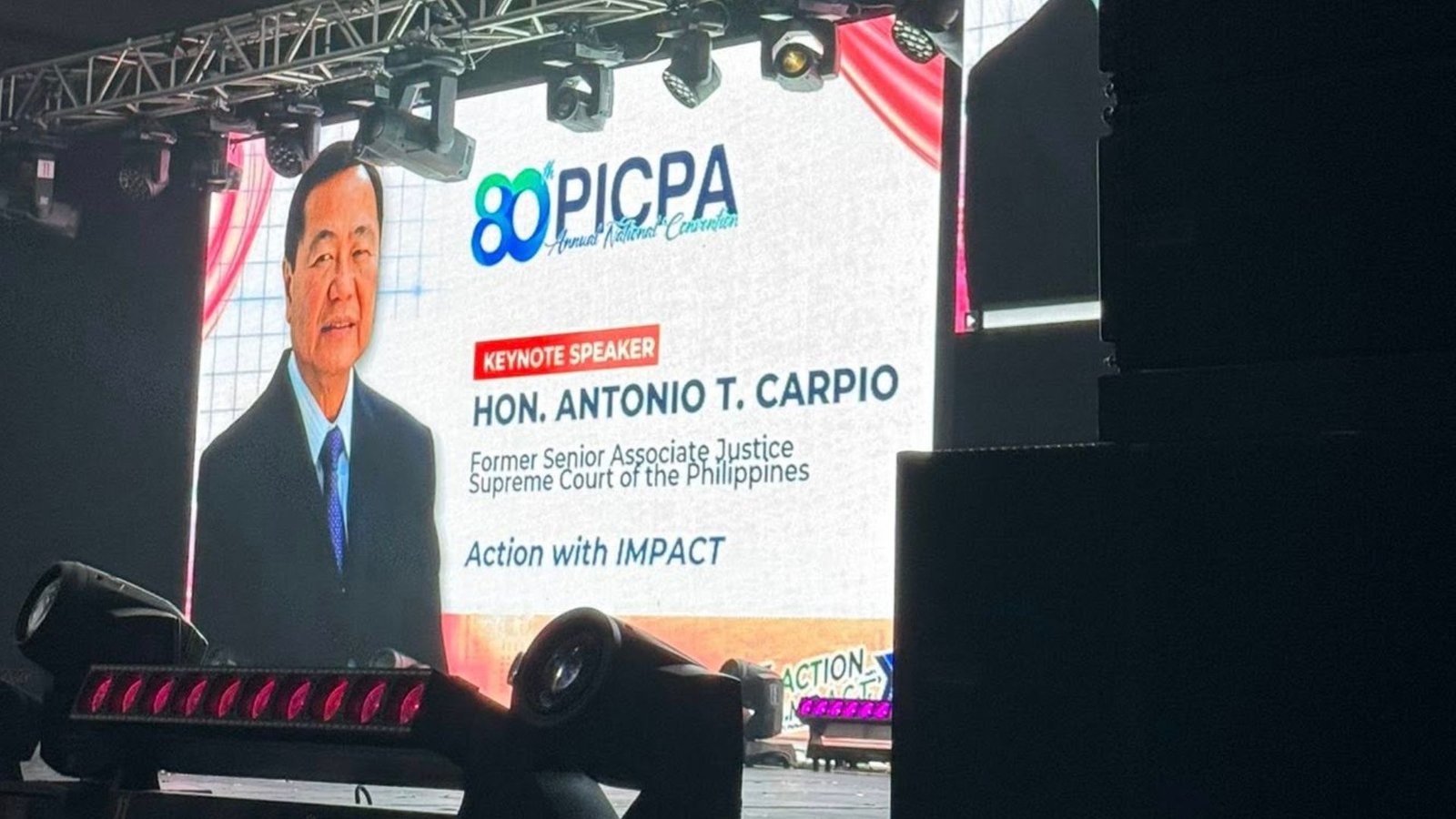
Former Senior Associate Justice Antonio T. Carpio once again took center stage in the national conversation on the West Philippine Sea as he delivered a powerful keynote address during the 80th ANC at SMX MoA. Armed with centuries of cartographic evidence and official maritime records, Carpio laid out—methodically and unmistakably—the historical and legal foundations that bind Panacot, Bajo de Masinloc, and Scarborough Shoal as one and the same Philippine territory.
Reconstructing Panacot Through Centuries of Maps
Carpio opened his presentation with a simple but forceful assertion:
“Panacot is Scarborough Shoal.”
The statement was not rhetoric—it was a conclusion built upon a meticulous collection of maps, journals, and hydrographic records dating back to the Spanish colonial period.
From the 1734 Murillo Velarde map, the first official Spanish map defining Philippine territory, he showed Panacot clearly positioned within the administrative domain of Manila. Carpio emphasized that this was centuries before modern disputes, and long before China’s contemporary attempts to rewrite the region’s geography.
Modern Distortions, Old Maps
One of the most jarring portions of the presentation addressed China’s September 2025 declaration of a “Huangyan Island National Nature Reserve” at Scarborough Shoal. Carpio underscored how the Philippine Department of Foreign Affairs immediately protested the move, which brazenly ignored centuries of established record placing the shoal under Philippine authority.
The Shoal’s Immense Value—Even the Smallest Rock Matters
Carpio’s discussion turned from history to maritime law when he presented an image of a tiny rock that remains visible at high tide. Under UNCLOS Article 121, he reminded the audience, this single rock legally generates a 12-nautical-mile territorial sea—a maritime zone amounting to over 155,000 hectares.
That’s twice the size of Metro Manila, rich in fisheries and natural resources that have supported Filipino communities for generations.
The lesson was clear: even the smallest feature carries enormous national value.
Refuting Claims That “Panacot Is a Different Shoal”
Carpio dismantled attempts to suggest Panacot is distinct from Scarborough Shoal.
He cited:
- The 1792 Malaspina Expedition, which recorded Panacot at the same coordinates and with the same characteristics historically attributed to Scarborough Shoal.
- Centuries of European and Spanish logs documenting shipwrecks at the same formation.
- The 1808 Carta General del Archipiélago Filipino and its 1875 reissue—official hydrographic maps marking Bajo de Masinloc with depth soundings as the only significant feature in that region.
- A rare 1800 royal order commanding Spanish naval officers to precisely chart Bajo de Masinloc, confirming Spain’s formal exercise of state authority over the shoal.
Each layer of documentation strengthened a single storyline: the continuity of Philippine ownership.
Ending With an Unshakeable Conclusion
Carpio closed his keynote by distilling centuries of evidence into one irrefutable chain of identity:
Panacot = Bajo de Masinloc = Scarborough Shoal.
Different names, one location, one history, one rightful owner.
He reminded Filipinos that the claim is not built on emotion or nationalistic aspiration—it is anchored in proven historical continuity, documented state acts, and lived experience. Filipino fishermen have relied on Panacot for generations. No amount of narrative engineering can erase what the records—and the shoal itself—testify to.
The Path Forward
As China continues efforts to rename, reframe, and reassert claims over Philippine maritime features, Carpio’s keynote stands as an essential roadmap. It calls Filipinos back to the foundation of their maritime rights:
evidence, law, and history—not intimidation or invention.
Panacot is part of the Philippines not because we claim it loudly, but because history confirms it, law affirms it, and generations of Filipinos have lived it.
Safeguarding it is not merely policy—it is a duty.